FIRST
Fixed checks, in an instant
Rules that leave no room for argument run first: known bad addresses, known attack patterns, permissions that do not add up. A routine transaction that passes them, and passes a fast AI read, clears right away.
Building something? Launch it here. The testnet is open: add the network, get test $AIERC, deploy, and apply, all in one place.
On an ordinary chain, value moves the instant a key signs, before anyone checks whether it should. On Chaingentic, AIERC reads every transaction while it is still only a proposal: who is sending it, what they are allowed to do, what they intend, and whether it is safe. Then Chaingentic settles it.

Most blockchains run a transaction the moment gas is paid and a valid signature arrives. That proves a key signed it. It does not prove the movement is suitable, intended, within policy, or even understood by the person or agent sending it.
Chaingentic changes the order. At the sequencer, before the block seals, the transaction pauses and AIERC reads it: what is happening, what authority exists, what policy applies, and what the sender actually intends. The reading happens off the chain, so nothing about it is slow for anyone else. Routine activity clears in that instant. When something does not add up, only that one transaction waits for its answer. The chain keeps producing blocks for everyone else.


AIERC protects users from malicious attacks, and it stops users from launching malicious attacks against others. It reads every transaction in both directions. The result is a fraud-free community.
Any EVM network can have this, three ways. Build on Chaingentic, where it is part of every block. Run the AIERC SDK in your own chain’s block building. Or let each user point the wallet they already have at our protected RPC. Each one works on its own. No new wallet, no migration, no rebuild.
Every transaction comes back CLEAN or FLAGGED. What happens next is your setting. In approval mode, you see the facts and you decide. In autonomous mode, the determination is final and you are told what happened. A FLAGGED transaction follows your own block preference: stop it, or show you the facts and let you choose. Stopping is the default.
Rules that leave no room for argument run first: known bad addresses, known attack patterns, permissions that do not add up. A routine transaction that passes them, and passes a fast AI read, clears right away.
Two AI reviewers from different model families read the transaction separately and must agree. Where the product includes it, a case the two cannot confirm moves up on its own to a panel of seven, and five of the seven must agree. You are never asked to run it.
CLEAN goes through. FLAGGED follows the block preference you set, in the mode you chose. Either way, the reasoning is written down before any value moves, and anyone can read it on the explorer.
AIERC is the intelligence that decides whether value should move. Chaingentic is the chain where AIERC runs natively and where cleared activity settles. Around them sit the token standard, the native token $AIERC, and a public record of every decision.
AIERC is a standard, not a token. It layers AI reasoning onto value movement on any EVM chain, to decide whether each movement is permitted, intended, suitable and safe before value moves. Intent is the part nothing else on chain can see: a movement can be perfectly valid and still be the wrong thing to do.
An EVM-compatible network, so Ethereum tools work as they are. Its architecture is a Polygon CDK validium, with AIERC built into block production: every transaction is examined off the chain, at the sequencer, before the block seals. The public testnet, chain 1002, is open now. Mainnet is not open yet.
A platform on Chaingentic issues its own token through the evaluated mint. Before the token exists, AIERC reads its code. After that, every transfer asks for its verdict, and the record follows the transaction. How it works.
The native token of Chaingentic. It pays for gas, and it pays for the AI that evaluates your transactions. Its design follows Ethereum’s model as closely as it can. On the testnet it is free from the faucet, and there are no fees.
The transaction keeps its own ID, its TXID. The intelligence behind it gets an ID of its own, its ITXID, written on Chaingentic. Paste either one into the explorer’s report page and read what was decided and why.
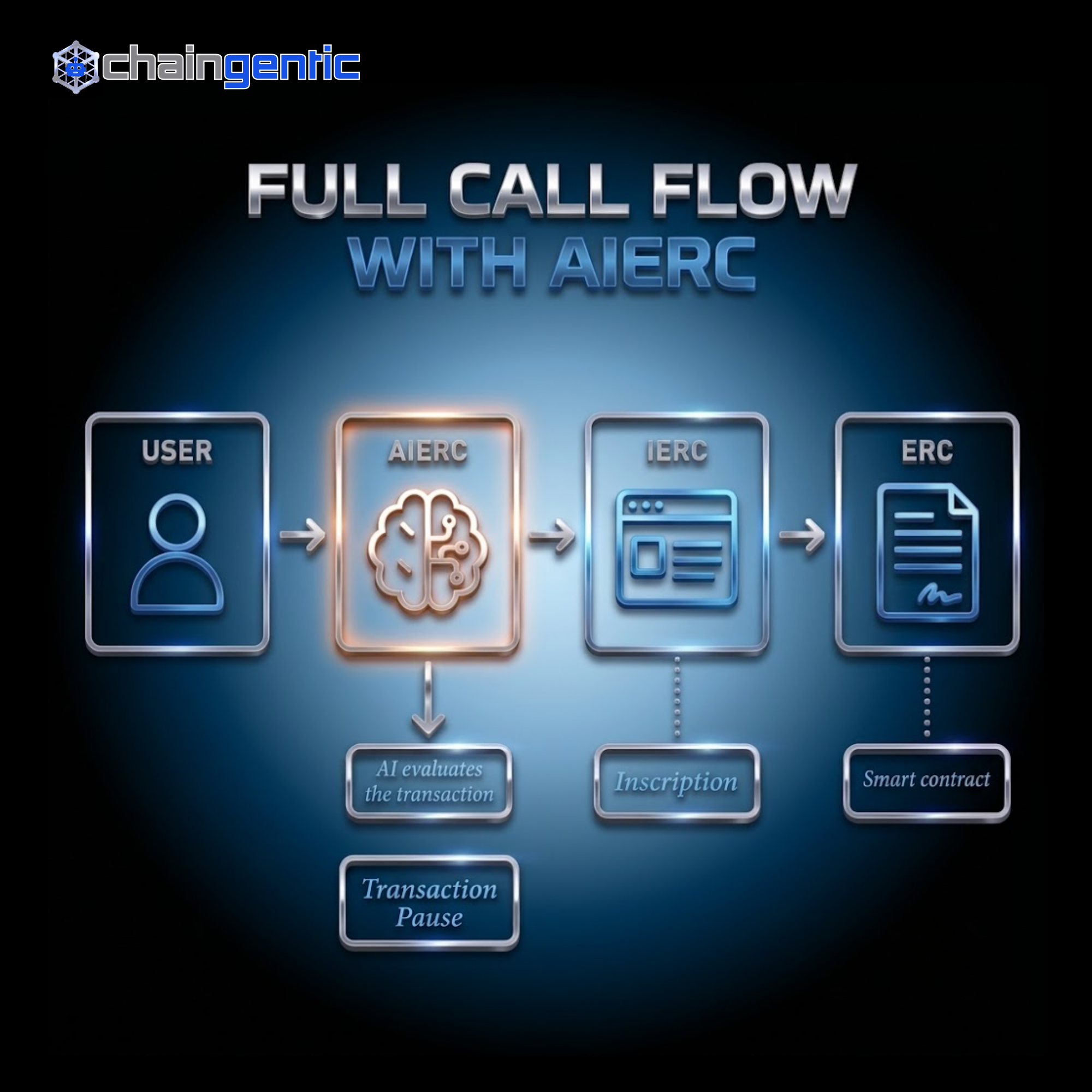
A person or an agent starts an action. At the sequencer, before the block seals, the transaction pauses. AIERC reads what is happening, what authority exists, what policy applies and what the sender intends, then returns one signed determination. Only then does the block seal and the contract receive the action. The pause lasts as long as the determination takes, and only for that one transaction.
The simplest way to say it: AIERC does the reasoning, Chaingentic runs and settles the transaction, and the user gets protection, and a record of it, before value moves.
Paygentic is a non-custodial platform for buying and selling with AI agents, built on the AIERC standard and Chaingentic. It is here so you can use Chaingentic, not just read about it.
Get an agent, give it a job and your limits, and let it buy or sell. Every deal is checked by AIERC before value moves, and its record lands on the Chaingentic explorer, where anyone can read it.
A marketplace, a wallet, a payments app, a game or an agent service: anything that runs on the Ethereum Virtual Machine runs here, and every transaction it sends is read before it settles.
AIERC meets users and builders wherever protection is needed: at the network, in the wallet, inside the token itself, and in the browser where wallets get connected.
Chaingentic runs AIERC natively. Any other EVM network can run the AIERC SDK in its own block-building step, so its transactions are read before they are included.
Point the wallet you already use at our protected RPC. Every transaction is read before it leaves, and a FLAGGED one comes back with the facts in plain words. On Paygentic, the point-of-sale console says it out loud.
Issue your token on Chaingentic and the check travels with it. Every transfer, in any wallet, is evaluated and recorded before value moves.
Most people are robbed at the moment they connect a wallet to a website. AIERC-XT is a browser add-on that checks each site against known scams and sits between the site and the wallet, catching a dangerous request, such as a hidden approval or a wallet-draining signature, before it becomes a payment. A malicious wallet connection is the one refusal nobody can switch off.
The AIERC token standard ties a token’s transfers to AIERC. Before the token exists, the evaluated mint reads its code: a CLEAN contract is deployed exactly as written, and a FLAGGED one is never born. After that, every transfer asks for its verdict for that exact move, and the verdict is written down before value moves. It works today on the Chaingentic testnet.
When two sides make a deal through escrow, they choose how long the payment can be reversed, a minute, a day or a month, and whether a reversal returns all of the money or part of it. If fraud is found, or the agreed condition is met, it reverses exactly what the two sides agreed, as a new signed payment. No one else’s money is touched.
Every determination leaves a record you can read: the transaction that was proposed, what AIERC found, and the verdict it returned. Not a black box that says yes or no, but the reasoning itself, written down before value moved, on a public log anyone can check. Read the records on the explorer.
People, businesses and agents can each be verified: KYC for people, KYB for businesses, KYA for agents. Identity documents go to our verification partner, not to us. Every wallet starts with a reputation score of 600, and from there its own conduct moves it.
Hardware wallets, firewalls, browser warnings, and manual review all help — but they sit at the edge of the transaction flow. AIERC is different: it evaluates admissibility before settlement.
| Feature | AIERC | Hardware Wallet | Firewall | Manual Review |
|---|---|---|---|---|
| AI-assisted approval | Yes | No | No | No |
| Transaction evaluation | Yes | No | Partial | No |
| Plain-language explanation | Yes | Partial | Partial | Yes, but late |
| AI CONSENSUS escalation | Yes | No | No | No |
| Documented decision record | Yes | No | No | Partial |
Most agentic payment systems only ask whether an authenticated agent is allowed to use a payment method, account or credential. Chaingentic and AIERC go further: they ask whether the economic action itself should happen, before value moves. Our x402 facilitator does this for machine-to-machine payments: each x402 payment is checked first, then settled on Chaingentic.
Receive the proposed action from a person, agent, merchant, app, wallet or enterprise workflow.
Bind the action to its mandate: limits, recipients, revocation status, the owner’s preferences and enterprise policy.
Evaluate intent, authority, policy, security, the context of the transaction, and whether it should be admitted.
Check the route, the network conditions and whether the action can run as proposed.
Settle only when the AIERC clearance is valid and current. Anything questionable is held out of the block, not pushed through.
Write the proposed action, the AIERC decision and the receipt into one record anyone can audit.
Enterprises need autonomous workflows that stay inside approved mandates. AIERC gives teams a way to connect spending rules, delegated authority, transaction policies, and evidence records before settlement.
| Delegated authority | Bind actions to user, team, agent, or workflow mandates. |
| Spending controls | Apply limits, recipients, timing, route conditions, and revocation status. |
| Explainability | Present plain-language reasoning before sensitive actions settle. |
| Support and audit | Preserve evidence records for review, dispute handling, and compliance. |
Our patent-pending coverage is the off-chain AI reasoning, evaluation, orchestration, verdict generation, and decisioning — the intelligence that decides whether value should move. It does not cover $AIERC, the token standard, the deployed contracts, market activity, or any tradable asset.
More than 2,500 claims, filed in Canada at CIPO, application 3,304,029, and internationally under the Patent Cooperation Treaty as WIPO PCT/IB2026/052205.
Tell us what you are working on. The Chaingentic team will follow up with the right next step.
Email: contact@chaingentic.io